I have been finding it too hard to talk about Palestine, struggling to find the words for this latest horror, after so many years of protest, feeling dried up. The someone pointed this video out to me. Ten years ago now, myself and Jim Ferguson in Glasgow, saying and singing what we felt about Palestine through the words of many Palestinian poets in the wonderful publication A Bird is Not a Stone, which we both worked on translations of, and Scottish songwriter Robert Tannahill. Read more about the book here: https://www.thebottleimp.org.uk/2017/10/bird-not-stone-anthology-contemporary-palestinian-poetry-edited-henry-bell-sarah-irving/
My two main projects after leaving Poetry London, tell it slant poetry bookshop and the Poetry Translation Centre have both had significant milestones recently. Tell It Slant Books celebrated its 10th birthday on 13th December last year, after being founded in 2013 by myself and Mat Loryman. It has been a long and bumpy road, including being moved twice, but we are now happily settled in Locavore Govanhill, in Glasgow, with the amazing team of Christie Williamson and Carla Woodburn. Secondly, the Poetry Translation Centre in London, where I am Publishing Manager and currently covering the Director role while Erica Hesketh is on sabbatical, is celebrating its 20th birthday this year, with a series of events throughout the year. More details here: https://www.poetrytranslation.org/birthday
Lastly, I am very excited to announce that my first full collection of poetry, My Deep and Gorgeous Thirst, will be published by Verve Poetry Press in October of this year! More news to come on this. A significant year all round. Here’s to 2024!
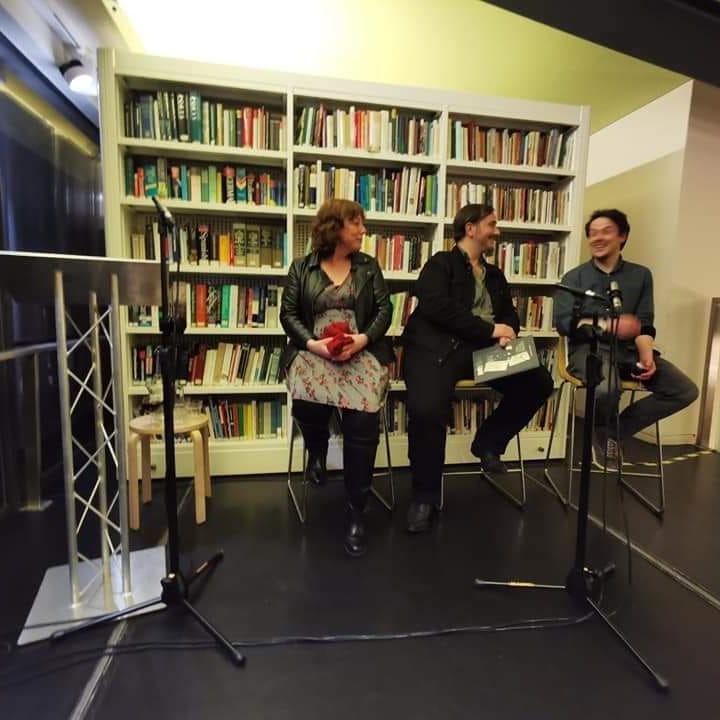
It was also wonderful to be back at Tell It Slant on Renfrew Street, the poetry bookshop Mat and I founded in 2013, with the current manager Shetland poet Christie Williamson, and events and digital manager Carla Woodburn, to discuss future plans for the bookshop. Exciting stuff ahead! Watch this space….
Christie and Tatenda, manager of Locavore Garnethill, along with a member of staff, holding up the old TIS sign unearthed from the back!
It’s here! My long-awaited pamphlet from Red Squirrel Press has arrived in the post today, and is available on their site at: This is now for sale on the Red Squirrel website, zoom launch soon! https://www.redsquirrelpress.com/product-page/honesty-mirror-ellen-mcateer . It had a splendid launch of sorts online at St. Mungo’s Mirrorball at a reading with Vahni Capildeo, Elizabeth Rimmer and William Bonar. A wonderful event reminiscent of Mirrorballs of old, making me miss Scotland more than ever! However, London life is about to get better as I got on to the Goldsmiths Creative Writing MA, which will start in September. So this little beauty is launching a really good year!
Many of the poems in this wee book remember my mother and father, who have both passed away, but taught me by example that it is never too late to be your true self. Here is the proof, with its own ISBN, that I am a POYET! I am sure they are both raising a glass somewhere…
I’m ashamed to see that my last post was well over a year ago, referring to the Poetry London Prize 2019! What a lot has happened since then. A terrible time in many ways, but a strangely good one for me as a writer, and for Poetry London, the magazine I have been working for for nearly three years now. This year’s Poetry London Clore Prizes were won by Eleanor Penny,Pat Winslow and S. Niroshini. Below are the links to the poems and biographies of the poets. I myself was lucky enough to be shortlisted in the Bridport Prize 2020, and win an Arts Council England grant to complete my first collection, tentatively titled Psychogeography, with the help of an incredible mentor, teacher and Forward Prize-shortlisted poet, Rachel Long, founder of the Octavia poetry collective for women of colour. I also started the process of making tell it slant, the poetry bookshop I founded in Glasgow in 2013, which is now being run by Shetlandic poet Christie Williamson, a Scottish charity. Looking at its website, I can see we need some updates there as well! Lockdown has been good for me, forcing a stillness and focus I rarely give to myself, leading to more writing, walking, and time with family. It has not all been easy – Covid-19 affected my family early on and there have been health consequences – but on balance, the way of life we have developed as a result is a gift. I also learned the lesson that as my own boss I am a slave-driver, and work too hard for my own wellbeing! I will try to be less hard on myself. I just hope the collective learning on lessening climate impact, local networks, community spirit, international collaboration, the importance of our NHS, and flexible learning and work patterns, stays with us all.
The biggest news we have at Poetry London is our new Poetry Editor, André Naffis-Sahely. A leading poet and translator, André was the Poetry Editor at Ambit for the last three years. He will takes over as editor from February, and his first issue in post with Poetry London will be Summer 2021. Martha Sprackland, who has managed the magazine so ably as Acting Editor, bringing in many innovations including facing page translations and originals in many languages, will step down after the Spring issue, to be launched February, when the Poetry London Competition will also be relaunched. After this, André will take over, with the Summer issue (our 99th!) as his first.
André Naffis-Sahely is the author of the collection The Promised Land: Poems from Itinerant Life (Penguin, 2017) and the editor of The Heart of a Stranger: An Anthology of Exile Literature (Pushkin Press, 2020) and is a translator with over twenty titles of fiction, nonfiction and poetry to his name. He will be a visiting fellow at Manchester Metropolitan University. He is from Abu Dhabi, born in Venice to an Iranian father and an Italian mother. I very much look forward to seeing the development of André’s plans for Poetry London in 2021.
The three winning poems were published in our autumn issue, and all can be read online here. You can also read interviews with Eleanor Penny, Pat Winslow and S. Niroshini by following the links in their names. Below is the judge’s report, by the hard-of-hearing Odessa poet Ilya Kaminsy.
Judge’s Report, by Ilya Kaminsky
I am so grateful to Poetry London for the chance to read so many incredible poems all at once, to immerse myself into various different tonalities, perspectives, voices. It was an experience of a lifetime. Each poet I read taught me something new. When the works arrived in my mailbox, I quickly realised there was something special about every piece I read.
I found it nearly impossible to choose from such a talented company of voices. I was asked to select just the winning poems, but I fell in love with so many more! Therefore, I simply can’t resist sharing these brief notes on a number of other marvellous poems that I was lucky enough for read for this competition. I hope they all find good homes.
First Prize: ‘Winter, a biography’ by Eleanor Penny
This poem travels from narrative to lyric and back, making many interesting, mysterious discoveries along the way. The author looks at the world and finds something utterly strange, teaching us to love it: ‘I held the weight of snow in my arms like a sleeping animal’.
Second Prize: ‘1971, Northaw’ by Pat Winslow
This prose poem has an otherworldly quality. ‘I saw myself. What I mean is I saw myself inside the tree’, the journey begins, taking us to the unexpected.
Third Prize: ‘Letters to Sunny Leone’ by S. Niroshini
The perspective here won me over instantly. The way the author observes how we live inside bodies, how we negotiate our days, and the (lack of) possibilities, is unique.
Highly Commended:
‘Mantelpiece with Bananas’ by Luke Allan: This poem is terrific; like a painting done by a master, with psychological insight and nuanced brushstrokes.
‘Evening Scene’ by Mel Pryor: This poem is a moving elegy that becomes far more than an elegy. The voice here is memorable and renders the emotion with clarity and poise.
‘untitled’ by Sean Cooper: This piece finds a surprising music for civic commentary, and ensures that the commentary is memorable as the music is touching.
Notable mentions:
‘Tallow Beach’ by Laurie Keim: The music of this poem is inimitable. I was thinking of Stevens, but, really, this music is all its own. Beautiful work.
‘Lobotomy’ by Natalie Crick: This poem does so many things: it is moving, it is vivid in its imagery, it is unexpected in its thinking. Wonderful.
‘Trespassing’ by John Haynes: ‘A spirit with long pointy elbows runs’ begins this poem, and it goes on where I least expected. I loved it.
‘Republic of Mackerel’ by Mukahang Limbu: The vivid imagery in this poem is electrifying. I thought of Lorca: ‘poet is a professor of five senses.’ Indeed.
‘Bible Study’ by Angelina Mazza: This inventive brief lyric had real emotion and marvellous delivery. A delight.
‘Eve’ by Mari Dunning: The humor and insight couple here to make something entirely new from an ages-old parable.
‘You are An Aubergine’ by Luke Yates: This poem constantly surprised me. Such good energy. I mean: when you get ‘a barbershop quartet of pregnant liquorice parrots,’ what else do you need?
‘Secret life of the house at night’ by Claire Allen: The insight here is unmistakable. The attentiveness to detail made me think of Simone Weil’s suggestion that ‘absolute unmixed attention is a prayer’.
‘Poem Where Every Bird is a Drone’ by Tarik Dobbs: I loved the invention and passion of this poem, its bravery to go into uncharted territory and assert that ‘conspiracy comes true: a tree in which every bird is a drone’.
‘Variations on a Theme from Isaac Holland’ by Seán Martin: What a graceful poem, and with such a heartbreaking final stanza: ‘where a woman / stood on some rocks in a storm / and screamed at the sea’.
Eleanor Penny is a poet, essayist and journalist based in London. Her awards include the Verve Poetry Festival Prize 2020 and multiple prizes with the Young Poets Network. A former Barbican Young Poet, she has twice been shortlisted for Young People’s Poet Laureate for London. She has been commissioned by the Poetry School, the Barbican and the Cinema Museum. Her non-fiction work has been featured in publications including the New Statesman, In These Times, the Independent and the London Review of Books. She hosts the poetry podcast ‘Bedtime Stories for the End of the World’. Her debut book is forthcoming with flipped eye.
Pat Winslow worked for twelve years as an actor before leaving the theatre in 1987. She has published seven collections, most recently Kissing Bones. Pat also works as a storyteller. She collaborated with composer Oliver Vibrans on her version of ‘The Coat’, a folk tale from the Caucasus, for the Royal College of Music last year. For more information see www.patwinslow.com.
S. Niroshini is a Sri Lankan-born writer and poet based in London. She is the author of a forthcoming pamphlet with Bad Betty Press and has published work in The Good Journal, On Bodies (3 of Cups Press), adda stories and harana poetry. She is working on her debut novel.
Luke Allan is poetry editor at Partus Press and co-editor of the journals Pain and Oxford Poetry. He studied literature and creative writing at UEA and Oxford and is former managing editor at Carcanet Press and PN Review. He received the 2019 Charles Causley Prize, placed third in the 2019 Mick Imlah Prize and the 2020 Poets & Players Competition, and was highly commended in The Rialto’s 2020 ‘Nature & Place’ Competition. He is currently working on a first collection.
Mel Pryor’s collection, Small Nuclear Family (Eyewear, 2015), was chosen by Bel Mooney as a poetry choice in the Daily Mail and the TLS described it as ‘a remarkable debut’. She was a 2017 Huffington Post poet to watch and in February 2018 she was the Scottish Poetry Library digital poet-in-residence as part of ‘The Blue Crevasse’ project. Recently her poetry has been published in Poetry Review and Magma and her short fiction in Ambit.
Poetry London have announced the Poetry London Clore Prize winners for 2019.
1st Prize: Roger Bloor
‘The Ghost of Molly Leigh Pleads, Yes Cries for Exemplaire Justice Against The Arbitrary, Un-exampled Injustice of Her Accusers’
2nd Prize: Amaan Hyder
‘duas’
3rd Prize: Anita Pati
‘Manju’
Highly Commended
Catherine Higgins-Moore: ‘I’d been waiting months’
Nicholas Murray: ‘WODGE’
Winners will be published in the Autumn issue of Poetry London, and on 23 October Judge Sasha Dugdale will present the Poetry London Clore Prize at Kings Place in Kings Cross N1, with readings from the prizewinners. More details and judge’s report at: http://poetrylondon.co.uk/.
Roger Bloor is a retired consultant psychiatrist, currently a student on the MA in Poetry Writing from Newcastle University studying at the Poetry School in London. He has been published in Magma, The Hippocrates Prize Anthology 2017 and 2019, Affect Publications StillBorn and several anthologies. His pamphlet A Less Clear Dream was shortlisted for the Arnold Bennett Book Prize 2018, and his poetry book Aldgedeslegh was shortlisted for the Arnold Bennett Book Prize 2019. He is Poet in Residence 2018/19 at the historic award winning Trentham Gardens in Staffordshire.
Amaan Hyder‘s first collection of poems is At Hajj (Penned in the Margins, 2017). His pamphlet when it is beyond was shortlisted in The Rialto Open Pamphlet Competition 2018.
Anita Pati was born and raised in the North West of England but now lives in London. She has won the Wasafiri Prize for Poetry and most recently was a winner of the inaugural Women Poets’ Prize. Her forthcoming pamphlet is Dodo Provocateur, published by The Rialto later this year.
Catherine Higgins-Moore is a Northern Irish writer based in New York. She was commended in BBC’s International Playwriting Award 2018 is nominated for the inaugural Harper Collins Comedy Women in Print Prize. She writes for The Times Literary Supplement and is founding editor of The Irish Literary Review. Her poetry collection Strange Roof was published by Finishing Line Press in the United States as part of their New Women’s Voices Series. Catherine is a journalist who has worked in the newsrooms of BBC Oxford and BBC Belfast.
Nicholas Murray is a biographer and poet living in the Welsh Marches where he runs the award-winning poetry pamphlet press Rack Press. He won the Basil Bunting Prize in 2015. His new collection The Yellow Wheelbarrow will be published later this year by Melos and he is the author of the hard-hitting pamphlet-length verse satire A Dog’s Brexit. His most recent collection is The Museum of Truth.
Sincere thank to Sheila Wakefield at Red Squirrel Press, who will be publishing my poetry pamphlet, Honesty Mirror, in Summer of 2020! When it won the New Writer Magazine prize in 2013, judged by Helen Mort, I was just setting up tell it slant poetry bookshop, and had not long finished my Clydebuilt Poetry Apprenticeship with Sandy Hutchison, now sadly no longer with us. Sandy asked how much the prize money was, then said I should use it to publish the pamphlet straight away, as publication (expect in the magazine) was not part of the deal. I was unsure about self-publishing and didn’t take his advice. His other advice was to slow down, and I found that easier to take!
Between the mad events of Glasgow, Aldeburgh, Beccles and London, and the loss of my Mum, I did not actually get round to sending it to a publisher till 2018, when I was lucky enough to get a job with Poetry London, and moved here, finding a great new poetry group at the Southbank Centre to replace (as much as it could) the wonderful group in Suffolk to which I belonged, along with Beth Soule, Kaaren Witney, Sue Wallace-Shaddad and Sue Mobbs, and to whom, together with my friend, Gutter Magazine editor Henry Bell, I have to credit the improvement since of many of the poems in the pamphlet. Meanwhile, Helen Mort had published me in One for the Road and kindly wrote a very nice review of the pamphlet that I was able to send out to publishers. In the end I only sent it to one – Red Squirrel, as recommended by a lifelong poetry mentor, Gerry Loose. They said yes!
I try not to berate myself for the delay in sending it out, and think instead of the improvements and additions I have been able to make, and the delightful fact that Red Squirrel now has Gerry Cambridge of Dark Horse fame doing the typesetting, making for even more beautiful books. I can’t wait to see what they do with mine.
Meanwhile, here is a note on the roots of the title, which came from an actual mirror, designed by Frances Macdonald, Charles Rennie Mackintosh‘s sister-in-law, decorated with a representation of the honesty plant. Entertainingly (to me anyway) inside the beautiful frame, it is a small, obscure, aged mirror now lodged behind a glass screen in the museum, making it very hard to see a reflection at all! The first I saw of it was actually a black and white photograph, also of course unreflective.
The eponymous poem, which came out of a Clydebuilt workshop, can be read here, where it was first published. Sincere thanks to Gutter Magazine, The North, Aesthetica, New Writing Scotland, New Writer Magazine, and in the anthologies One for the Road (2018),Dove Tales (2018), Glasgow Women Writers (2017) and The Skye Reading Room Anthology 2013 (for the Baker Prize), where many of the poems in this pamphlet were previously published. The poem ‘Found in Translation’ won the 2017 Waterstones NorwichRefugee Week Poetry Prize. ‘Mourning in Arduaine’ was translated into Dutch for the magazine Awater.
I look forward to the launch in July 2020 – hoping to come full circle and launch it at tell it slant, now managed by the wonderful Shetlandic poet Christie Williamson.
‘Landscape becomes a character in the taut poems of ‘Honesty Mirror’, poems which chart both the inevitable – ‘water pulling sky to sea’ – and the surprising - ghosts glimpsed in the mirror, supernatural glimmers on a city street – with precision and grace. We find ourselves in a strange, familiar place where ‘our faces are the only language we have’.’Helen Mort.
I am very pleased to have two poems in this great anthology put together by poet Derek Parkes to honour the great influence Donny O’Rourke has had on contemporary Scottish poetry. Love the intro: ‘Throw a brick into the air in Glasgow, chances are it will land on a poet.’ Aye, ah widnae try it though, mate…
In other news, I have been asked to be on the board of Tell It Slant poetry bookshop as it becomes an official entity under Christie Williamson‘s wise stewardship. I was so touched to be asked. TIS was started as a popup in 2013 by myself and Mat, and it refuses to pop down, with poets Kathryn Sowerby, Gerry Loose and Christie all putting their love into it. Glasgow loves poetry. Poets love Glasgow. Despite the danger of falling bricks.
I’m really pleased to be sharing this poetry film of my poem ‘The Dark Museum’ from Near Future. The film was made by Helen from Elephant’s Footprint and the process of making it was really interesting too.
When Helen initially told me that she wanted to use this poem, I was a bit worried because it’s actually about the absence of the visual. The poem’s subject is a museum where visitors can experience different kinds of darkness, the idea being that we rarely experience true darkness in our world of light pollution. I was therefore really interested to see where it would go. I tend to describe myself as ‘not having a very visual imagination’ and tend to be quite focussed on sounds and smells in my own creative thinking, so I was really keen to give someone free rein to work in dimensions that I had perhaps not…




 Ellen McAteer